
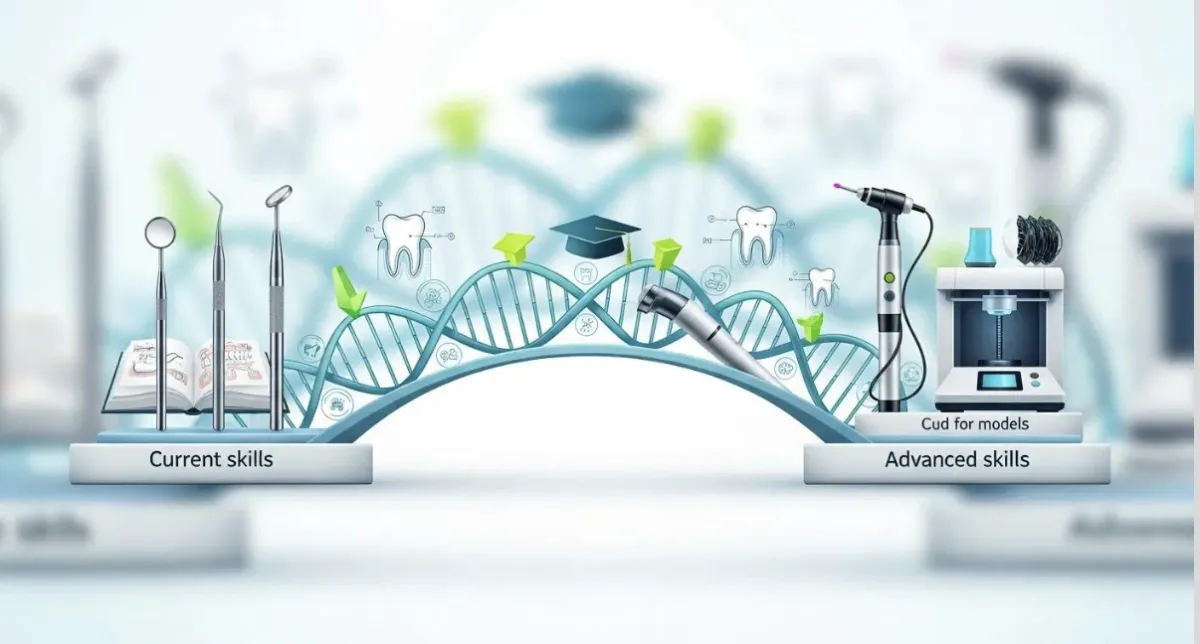
Bridge Dental Skill Gaps
Bridge Dental Skill Gaps
Dental practices encounter training gaps when staff skills, knowledge, or behaviors fall short of defined performance expectations, and these gaps directly affect patient care quality, operational efficiency, and practice revenue. This article explains what training gaps look like in a dental office, why closing them matters for patient outcomes and staff retention, and how to run a practical needs assessment that leads to measured improvement. Readers will learn step-by-step methods to identify gaps using performance data and observation, role-specific training pathways for front office, hygienists, and assistants, and how to choose training software and coaching models that support competency and culture. The guide also covers measurement: which KPIs show impact, how to calculate ROI from training, and a continuous-improvement loop to refine programs over time. Throughout, the focus is practical: you will get checklists, comparison tables, and implementation tactics for onboarding, SOPs, CPD tracking, and coaching that work in contemporary dental practices. This sets the stage for the first operational task: a systematic approach to identifying training gaps that prioritizes patient safety and business outcomes.
Indeed, research confirms that such gaps are a common challenge, with significant variability in how dental professionals utilize their full range of skills.
Identifying Skill Gaps in Dental Practice Workforce
Around one third of dental practices reported employing dental nurses with additional skills (n= 74, 32.5%) or dental therapists (n= 73, 32%), and nearly half employed a dental hygienist (n= 104, 46%). However, there was considerable variability in whether these staff actually carried out the range of skills within their scope of practice.
Development and retention of the dental workforce: findings from a regional workforce survey and symposium in England, RD Holmes, 2020
H2: How to Identify Training Gaps in a Dental Practice?
A training needs assessment in a dental practice defines desired role-based outcomes, collects objective and subjective data, analyzes discrepancies, and prioritizes gaps that most affect patient care and revenue. The mechanism is simple: define "what good looks like" for each role, then measure actual performance against those standards using multiple data sources; the benefit is targeted remediation rather than unfocused training that wastes time and budget. Clear competency matrices link observable behaviors to measurable KPIs so decisions move from anecdotes to evidence, improving adoption and accountability. The next subsection lists the practical steps you can follow immediately to discover and validate gaps across your team.
Follow these steps to identify training gaps and why each matters:
Define role outcomes: Create competency statements for each role that describe expected behaviors and results.
Collect data: Use performance reviews, patient surveys, and clinical KPIs to capture objective and subjective performance signals.
Triangulate findings: Cross-check at least two sources (for example, KPIs and direct observation) before flagging a gap.
Prioritize by impact: Rank gaps by patient-safety risk, revenue impact, and frequency to focus resources.
This step-based approach ensures you target the highest-impact gaps first and prepares you to collect the specific data sources described below.
H3: Data Sources for Gap Discovery: performance reviews, surveys, and KPIs
Primary data sources for gap discovery include quantitative metrics from the practice management system, qualitative feedback from patient and staff surveys, and structured observations during clinical workflows. Quantitative KPIs to monitor include appointment no-show rates, treatment acceptance/decline rates, average chair time, and coding/billing error rates; qualitative sources include patient experience scores and anonymous staff feedback. Triangulation means you confirm a signal across at least two sources—for instance, rising no-shows plus low patient communication scores suggests a front-desk scheduling or messaging gap.
A short gap-discovery checklist to use in practice: (1) list desired outcomes, (2) extract three KPIs per role, (3) run a five-question patient survey focused on communication and timeliness, and (4) observe two workflows to validate suspected gaps. Using multiple sources reduces false positives and directs remediation where it will move the needle.
H3: Which Roles Show the Most Critical Gaps: front office, hygienists, assistants
Front office staff often show gaps in scheduling optimization, insurance verification, and patient communication that directly affect revenue and patient flow.
Hygienists commonly need continuous education on advanced clinical protocols, improved treatment acceptance conversations, and recall management skills that influence preventive care outcomes and chair utilization.
Dental assistants frequently require refreshers on instrument setup, sterilization procedures, and auxiliary clinical techniques that ensure safety and efficient operatory turnover.
Prioritization should weigh which role gaps most frequently disrupt appointments or risk compliance; addressing front-office communication and scheduling first often yields the fastest operational gains and sets the stage for clinical upskilling that increases treatment acceptance.
H2: Core Dental Office Staff Training to Bridge Gaps
Core training for dental teams should map directly to the competency matrix established in the needs assessment and use a blend of microlearning, hands-on coaching, and continuing education to reach measurable outcomes.
The mechanism is role-aligned, competency-based training: each module targets a discrete skill or procedure, includes an assessment rubric, and specifies the expected performance level; the benefit is faster time-to-competency and clearer verification for managers.
This approach aligns with the broader trend in dental education towards competency-based models, ensuring graduates and practitioners possess the necessary skills and behaviors.
Competency-Based Education for Dental Practice Skills
Competency-based dental education focuses on the knowledge, professional skills and behaviour required of new graduates. Increasingly, the current trend is towards competency-based education, which provides a sequence of defined learning experiences to students so that on graduation they may be considered as qualified beginners in dental practice.
Review of competency-based education in dentistry, 2000
Training pathways combine online modules for knowledge, in-practice mentoring for applied skills, and periodic assessments to certify capability
The following role-based checklist and table map common gaps to recommended training so practices can design prioritized learning plans that balance clinical safety with patient experience improvements.
Front office training should include administrative workflows, scheduling best practices, and compliance modules to reduce errors and improve patient experience. Core modules cover insurance verification workflows, scripting for difficult calls, digital check-in processes, and HIPAA basics; formats that work well include short video micro-lessons, role-play sessions, and standard operating procedure (SOP) checklists.
Onboarding checklists should list credential verification, scheduling rules, and escalation paths; assessment combines quizzes and observed interactions. Regular refresher sessions every 3–6 months reinforce change and tie completion to performance reviews and tangible metrics like reduced no-shows and faster patient check-in.
H3: Front Office Training: admin, scheduling, compliance
Front-desk training emphasizes accuracy in intake, clarity in communication, and speed in scheduling operations to improve throughput and patient satisfaction. Specific training items include verifying benefits before appointments, scripting for treatment acceptance conversations, and managing recall lists; practical formats are brief role-play blocks and SOP-driven microlearning modules.
Assessments should combine competency checklists with mystery-shop style patient calls to measure real-world communication.
A scheduled cadence of refresher training—quarterly mini-sessions and an annual comprehensive review—helps sustain improvements and reduces repeated onboarding time for new hires.
H3: Hygienist Development: CE, advanced clinical skills, patient education
Hygienist development blends targeted continuing education, hands-on clinical training, and patient-education coaching to increase preventive care uptake and clinical quality. CE topics that yield measurable outcomes include periodontal therapy updates, instrumentation efficiency, and behavior-change counseling for oral health; combining online CE with in-clinic supervised practice accelerates skill transfer. Measuring improvement relies on treatment acceptance rates, recall visit adherence, and reductions in unmet treatment needs in patient charts. Mentoring from senior clinicians and peer-review of clinical techniques supplies the practical reinforcement necessary to convert CE knowledge into everyday practice.
Research consistently highlights the importance of evaluating such professional development initiatives to ensure they translate into tangible improvements.
Measuring Effectiveness of Dental Professional Development
This systematic review aimed to determine the effectiveness of continuing dental professional development on learning, behavior, or patient outcomes. The review included studies that evaluated interventions aimed at improving the knowledge and skills gain of members of the dental team (e.g., dentist, dental nurse) or dental care professionals (DCPs).
Systematic review of the effectiveness of continuing dental professional development on learning, behavior, or patient outcomes, 2013
This role-to-training mapping clarifies where to invest training hours and what outcomes to expect, enabling a focused rollout that aligns with your needs assessment and performance targets.
H2: Selecting and Implementing Training Software for Dental Teams
Choosing training software for dental teams requires aligning platform capabilities with core needs: onboarding flows, SOP libraries, CPD/CE tracking, assessments, and reporting that integrate with practice workflows.
The key mechanism is software that centralizes learning artifacts and tracks completion against competency matrices, yielding faster onboarding and audit-ready records; the value is consistent execution of SOPs and demonstrable CPD tracking for clinical staff.
Selection should begin with a feature-priority checklist and a pilot phase to validate user adoption; implementation focuses on data mapping to the practice management system and defining success metrics like completion rates and time-to-competency.
Below are must-have features explained and a comparison table to guide vendor conversations.
Must-have training software features for dental teams include onboarding automation, an SOP library with version control, CPD/CE tracking with certificate generation, and assessment/reporting dashboards. These features serve concrete purposes: onboarding automation standardizes new-hire tasks, SOP version control prevents process drift, CPD tracking supports regulatory compliance and professional development, and assessment dashboards show who needs coaching. Prioritize platforms that offer single sign-on, CSV export of completion records, and simple mobile access to support staff learning between patients. Implementation should follow a pilot→feedback→rollout sequence and measure adoption by tracking completion and baseline-to-post-training competency.
Onboarding automation: Automates first-day tasks and timed learning milestones, reducing time-to-productivity.
SOP library with version control: Stores standardized procedures with change logs so staff access the latest protocols.
CPD/CE tracking and certificates: Records earned credits and issues certificates for continuing education compliance.
H3: Must-Have Features: onboarding, SOPs, CPD tracking
Onboarding automation, SOP management with versioning, and CPD/CE tracking are essential features that reduce variability and support compliance in dental settings. Onboarding modules should include task checklists, credential upload fields, and scheduled mentor check-ins to shorten ramp time. SOP management needs access controls, searchable procedures, and a simple editor so clinical and administrative teams maintain consistent practice. CPD tracking must capture course completions, issue certificates, and export data for credential audits; these features together create a single source of truth for learning and compliance. Selecting software that bundles these capabilities accelerates implementation and provides measurable adoption metrics.
H3: Implementation Tips: PMS integration, user adoption, training rollout
A phased rollout—pilot a single location or team, refine content and mappings, then expand—minimizes disruption and surfaces integration issues early. Integration checklist items include mapping staff IDs between the practice management system and the LMS, ensuring secure authentication, and exporting completion data for HR records. Encourage adoption with short microlearning, gamified milestones, and manager-led check-ins that tie training to measurable performance goals. Monitor adoption via completion rates and time-to-competency and use these metrics to iterate on content and delivery, reinforcing successful changes with recognition and targeted coaching for low performers.
H2: Coaching, Leadership, and Professional Development in Dentistry
Coaching and leadership development focus on building the relational and managerial skills that turn trained individuals into consistent, high-performing teams; the mechanism is structured coaching cycles that combine observation, feedback, and measurable goals to improve performance and retention. Effective programs align coaching frequency and scope with role needs and measure impact through engagement scores and turnover metrics; this produces a stronger culture that supports continuous learning. The next subsections compare coaching models and outline mentoring and soft-skill curricula that directly improve patient experience.
Manager coaching: Focuses on performance improvement and accountability with measurable goals.
Peer coaching: Enables skill-sharing and faster adoption of clinical techniques through observation and feedback.
Mentoring programs: Support career growth and retention by pairing experienced staff with mentees over a defined period.
These coaching models complement formal training by reinforcing behaviors and building leadership capability, which prepares practices for sustainable improvement and lowers turnover through professional development.
H3: Coaching Models for Practice Performance and Retention
Structured coaching models—regular one-on-one sessions, peer-observation rounds, and short-cycle performance coaching—drive both performance gains and higher staff retention. One-on-one coaching aligns expectations and addresses individual barriers, while group coaching allows teams to share solutions to common workflow issues; both should include agreed action items and follow-up metrics. Measurement uses engagement surveys, number of coaching hours per staff member, and changes in turnover rates to demonstrate impact. Integrating coaching into performance reviews and linking progress to development plans increases buy-in and establishes coaching as part of the practice culture.
H3: Mentoring Programs and Soft Skills for Patient Experience
Mentoring programs structured over 6–12 weeks pair new hires or clinicians learning new skills with experienced mentors and include weekly check-ins, observed interactions, and role-play for soft skills. Soft-skill modules should emphasize communication, empathy, and difficult-conversation techniques tied directly to patient satisfaction metrics. Practical exercises like observed patient returns and scripted coaching deliverable outcomes that are measurable—improvements in patient satisfaction scores, better treatment acceptance, and smoother recall management. Embedding soft-skill expectations in SOPs ensures that these competencies are reinforced consistently across the team.
H2: Measuring Impact: ROI, KPIs, and Continuous Improvement
Measuring training impact requires defining core KPIs, collecting baseline data, applying the training intervention, and comparing post-training metrics to quantify ROI and guide refinement. Core KPIs include patient satisfaction, staff retention, revenue per chair, and efficiency measures like average chair time and treatment acceptance rate; tracking these with consistent cadence enables causation inferences. A continuous-improvement cycle—assess, implement, measure, refine—ensures that programs evolve based on data, and the table below shows recommended baseline and target values to help practices set realistic improvement goals. The next subsection provides definitions of core KPIs and practical formulas for tracking ROI.
Core KPIs for training programs are patient satisfaction (NPS or survey scores), staff retention (annual turnover %), revenue per chair (monthly revenue divided by active chairs), and efficiency (average procedure time and treatment acceptance rate). Data sources include PMS reports, HR records, and patient feedback systems; calculate changes in each KPI before and after training and use the delta to estimate revenue impact. For ROI, quantify incremental revenue or cost savings attributed to training (for example, higher treatment acceptance leading to more procedures) and divide by program costs; this produces a simple ROI percentage that guides investment decisions. Use the case-study template provided later to present results in a standardized, publishable way.
H3: Core KPIs: patient satisfaction, staff retention, revenue, efficiency
Define and calculate core KPIs using clear formulas: patient satisfaction via standardized surveys or NPS, staff retention as (1 − annual turnover rate) × 100, revenue per chair as total monthly clinical revenue divided by number of clinical chairs in use, and efficiency as average chair time per procedure. Recommended data collection cadence is monthly for operational KPIs and quarterly for retention and satisfaction trends. Benchmarks vary by market and practice size, but reasonable short-term targets after targeted training include a 5–10% lift in patient satisfaction and a 20–40% reduction in time-to-competency. Setting these targets in advance allows you to attribute changes to the training intervention and calculate ROI.
H3: Case Studies and Data-Driven Optimization
A simple case-study template—challenge, intervention, metrics, outcome—makes it straightforward to present training ROI to practice owners and stakeholders. For example, a front-desk communication intervention might show: challenge (high no-show and low satisfaction), intervention (scripted training + SOP updates), metrics (no-show rate, satisfaction), outcome (no-shows down 30%, satisfaction up 8 points), and ROI (incremental revenue from recovered appointments minus training cost). Anonymized examples are especially useful for internal reporting and for sharing best practices across multi-site groups. Regularly publishing these internal case studies supports a culture of continuous improvement and helps scale successful interventions across the organization.
Challenge: State the precise operational problem and baseline metrics.
Intervention: Describe the training or coaching program implemented.
Metrics & Outcome: Report before/after KPIs and calculate ROI where possible.
Using this structure keeps evaluations focused on measurable outcomes and ensures future investments target tactics that demonstrably move the needle.


Instagram
LinkedIn
X