

The Accountability Gap That’s Costing You Growth
Staff accountability is not a culture initiative.
It is an operational design decision.
Most dental practices do not struggle because their teams lack effort. They struggle because expectations, visibility, and follow-through are structurally inconsistent. When performance relies on reminders, personality, or end-of-month reviews, accountability becomes reactive and emotional.
Accountability improves when execution becomes measurable, visible, and embedded into daily workflow.
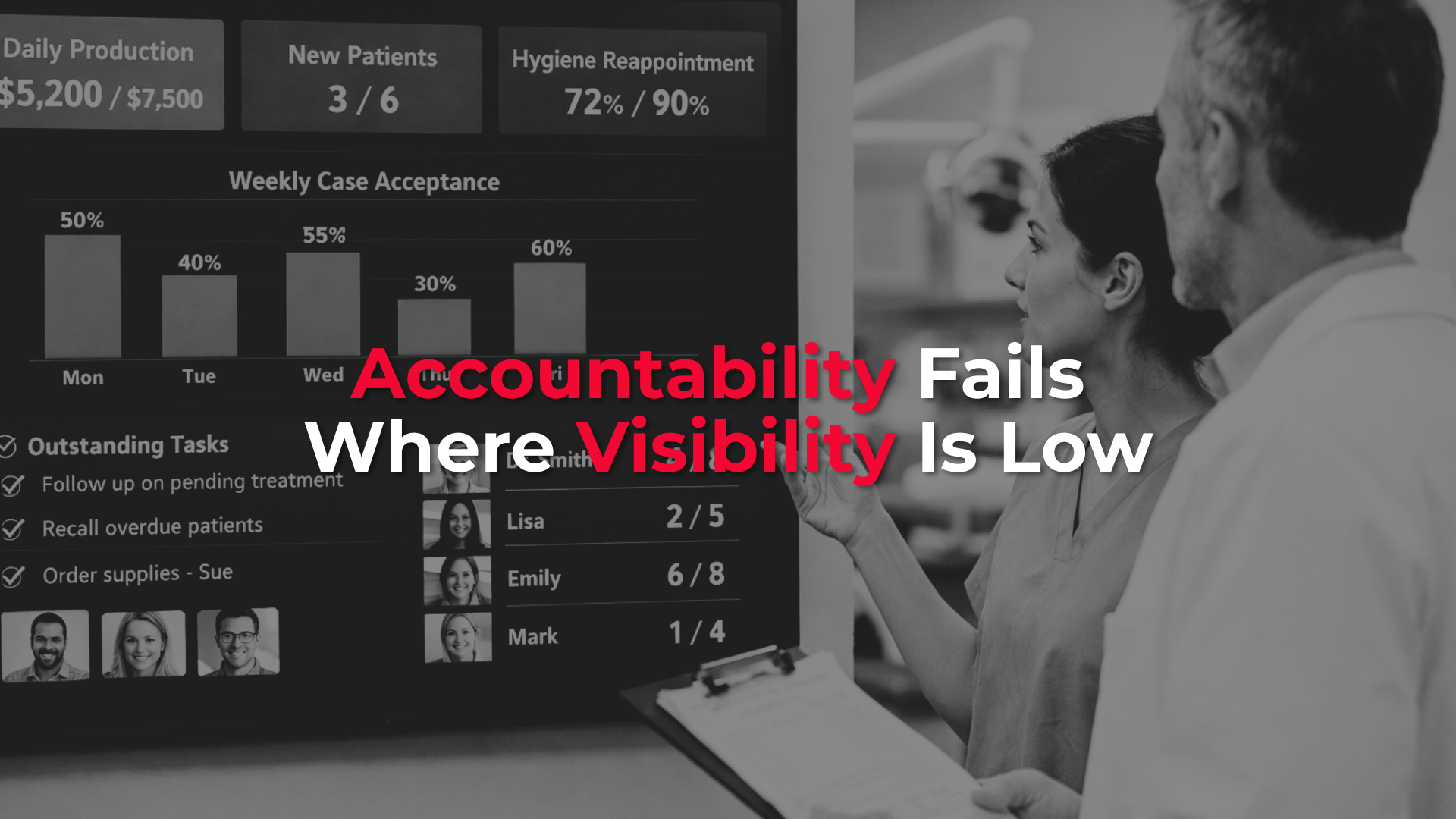
Accountability Fails Where Visibility Is Low
In many practices, goals are discussed in monthly meetings. Reports are reviewed sporadically. Gaps are addressed when production dips. By the time leadership reacts, the opportunity has already passed.
Accountability requires three structural elements:
Clarity – Every role must have defined success metrics.
Visibility – Performance must be seen daily, not monthly.
Ownership – Specific actions must be assigned and tracked.
Without these three components, conversations default to opinions rather than performance.

Define Role-Based Performance Standards
Accountability cannot exist without measurable expectations.
Each position should have 3–5 core indicators directly tied to revenue and operational health. For example:
Front Office: Scheduled Production %, Unscheduled Treatment Follow-Up %, Collection Ratio
Hygiene: Reappointment Rate, Periodontal Acceptance %, Same-Day Treatment Capture
Doctor: Case Acceptance %, Same-Day Production %, Treatment Plan Completion
If a team member cannot clearly articulate how success is measured in their role, performance management becomes subjective. Clear metrics eliminate ambiguity and protect high performers.

Shift From Reporting to Operational Monitoring
Monthly reporting is informational. Daily monitoring is transformational.
When metrics are reviewed only at month-end, the team cannot adjust behavior in real time. By contrast, daily visibility allows immediate course correction. For example:
If scheduled production falls below target today, it can be corrected today.
If unscheduled treatment accumulates, follow-up can be triggered immediately.
If hygiene reappointment drops, scripts and processes can be reinforced the same week.
Accountability strengthens when data drives daily action, not retrospective analysis.
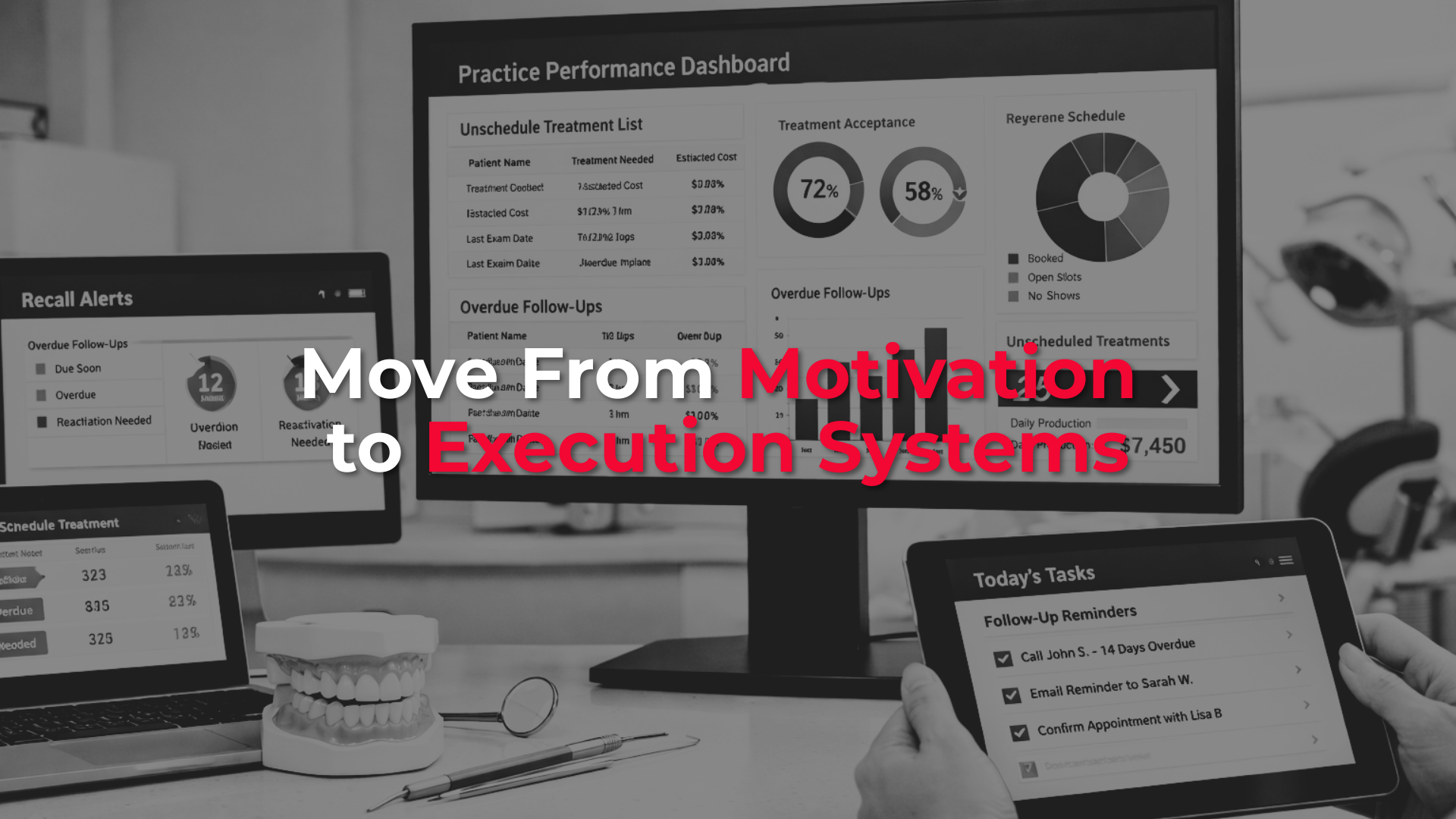
Move From Motivation to Execution Systems
Many practices attempt to improve accountability through culture initiatives: team-building exercises, bonus programs, motivational meetings. While culture matters, culture follows structure.
If systems do not surface gaps automatically, leadership must manually chase performance. That creates fatigue, inconsistency, and emotional friction.
Structured accountability requires:
Automated tracking of unscheduled treatment
Automated recall alerts
Automated reminders for overdue follow-up
Centralized dashboards with role-based visibility
When the system highlights what needs attention, accountability becomes procedural rather than personal.

Establish Daily Micro-Commitments
Accountability improves when large goals are broken into daily commitments.
Morning huddles should answer three questions:
Where are we against today’s production target?
What gaps must be closed before the end of the day?
Who owns each action?
Ownership must be explicit. Vague accountability produces vague results.
Small daily corrections prevent large monthly shortfalls.

Separate Performance From Emotion
One of the primary barriers to accountability is emotional framing. Conversations framed around effort or attitude often create defensiveness. Conversations framed around metrics create alignment.
Instead of:
“We need better scheduling.”
Use:
“We are at 64% scheduled production. Our target is 85%. What specific actions close that gap today?”
Objective metrics shift dialogue from blame to solution.
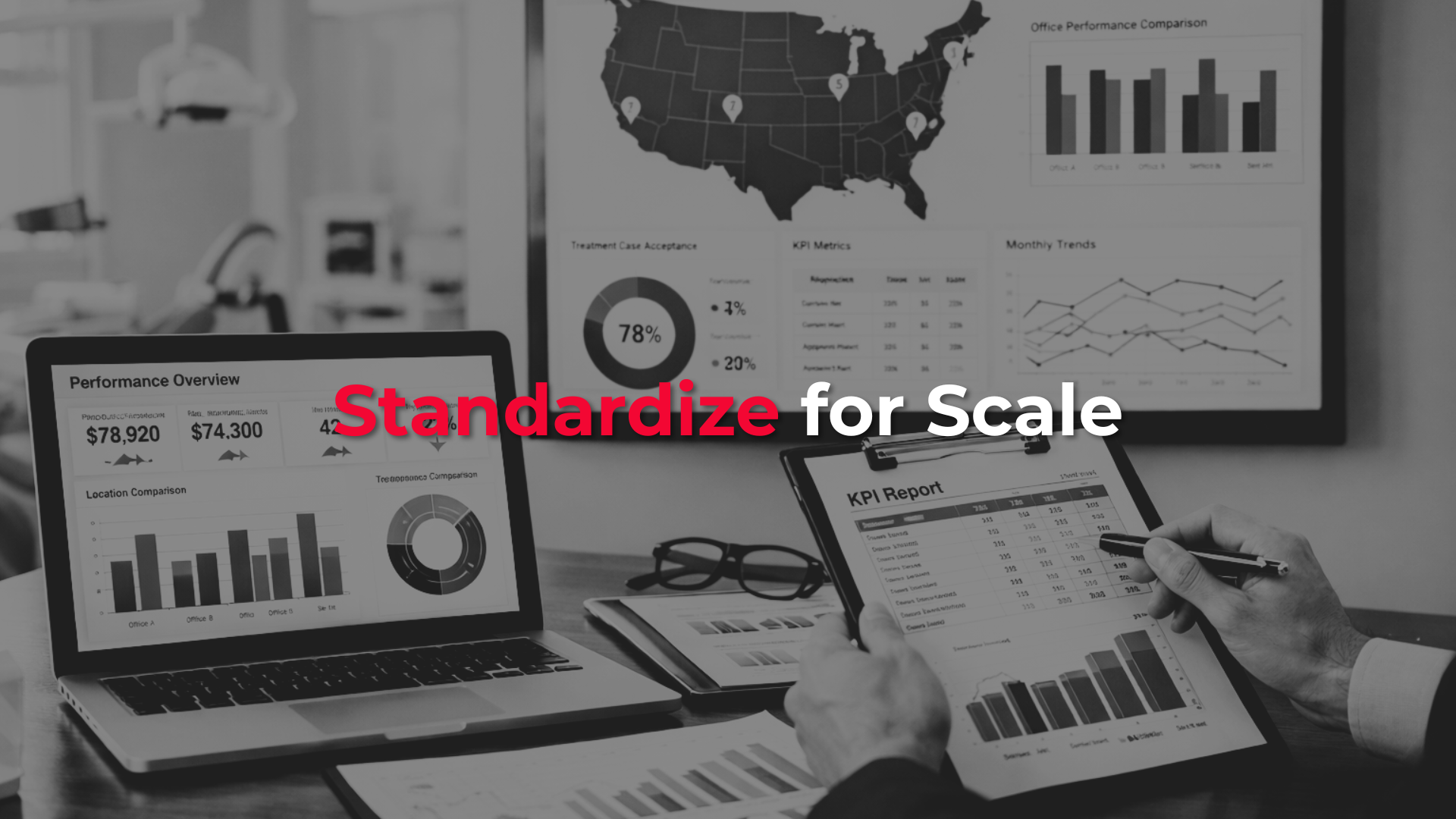
Standardize for Scale
For multi-location practices or DSOs, accountability must be systemized across offices. Variability in processes leads to variability in outcomes.
Standardized dashboards, defined KPIs, and consistent daily review structures allow regional leaders to:
Compare performance across offices
Identify execution gaps quickly
Shorten ramp-up time for new acquisitions
Replicate best-performing office behaviors
Consistency across locations strengthens portfolio-wide EBITDA by reducing operational leakage.

The Core Principle
Accountability is not about pressure. It is about precision.
When:
Expectations are clearly defined
Performance is visible daily
Gaps are surfaced automatically
Ownership is assigned consistently
Accountability becomes embedded in workflow.
The strongest practices do not rely on heroic leadership or constant reminders. They design systems where the right actions happen every day.
Performance improves not because people try harder, but because execution is structured.
Accountability is not enforced.
It is engineered.


Instagram
LinkedIn
X