
The ROI of Automation in Dentistry
Dentistry has never had more technology available to it than it does today. Practice management systems, analytics platforms, communication tools, marketing dashboards — the modern dental office is surrounded by software designed to improve performance.
And yet, many practices still experience inconsistent production, uncollected treatment sitting idle, hygiene gaps, reactive leadership, and limited operational visibility.
The issue is rarely a lack of technology. It is a lack of structured execution.
Automation, when properly implemented, is not simply about sending appointment reminders or generating reports. It is about creating a system that ensures the right actions happen every day without depending on memory, manual tracking, or heroic leadership effort. The return on automation in dentistry is not theoretical. It is measurable, operational, and financial.
Automation as an Execution System
Most dental software is passive. It records activity. It stores information. It waits for someone to check a dashboard.
But performance does not improve because data exists. It improves because data drives action.
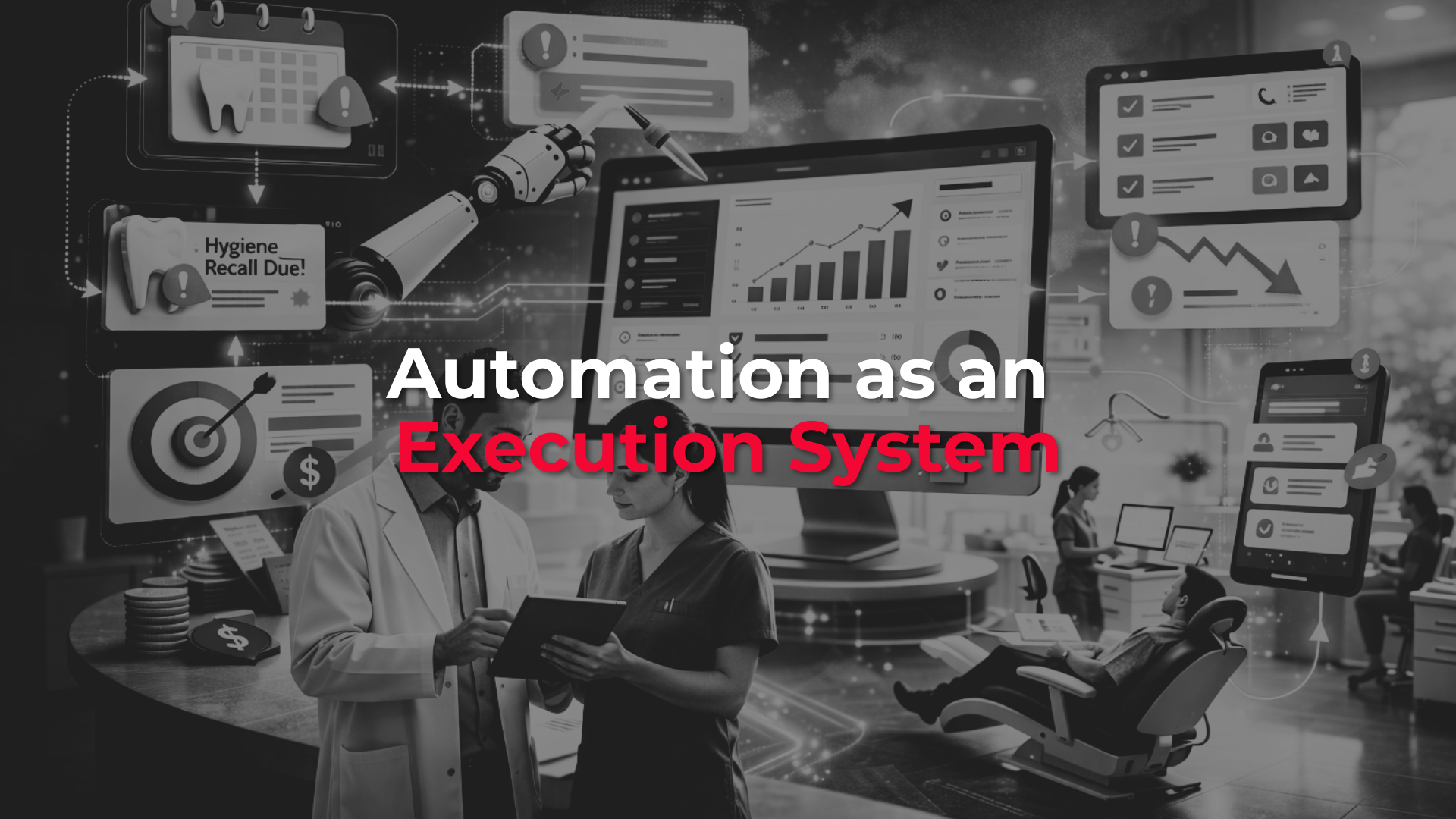
True automation transforms data into daily operational prompts. It identifies unscheduled treatment and surfaces it before it becomes forgotten revenue. It exposes hygiene reappointment gaps before they affect future production. It highlights daily production targets and makes underperformance visible early in the day rather than at the end of the month.
Automation becomes the operational nervous system of the practice. It connects information to behavior.
That shift—from passive reporting to active execution—is where return on investment begins.

Revenue Growth Without Expansion
One of the most overlooked aspects of automation is that it often increases revenue without requiring more chairs, longer hours, or additional providers.
Consider a $1.5–$2 million practice. A modest improvement in daily production—driven by better scheduling discipline, same-day dentistry capture, and consistent follow-up on open treatment—can generate meaningful annual lift. An additional $1,000 in average daily production translates into approximately $240,000 per year.
That level of improvement rarely requires new marketing spend. It usually comes from optimizing what already exists: unscheduled treatment plans, incomplete hygiene reappointments, short-notice openings, and delayed follow-ups.
Automation ensures those opportunities are not dependent on whether someone “remembers” to act. It makes revenue capture systematic rather than situational.

Reducing Revenue Leakage
Every practice experiences some degree of revenue leakage. Treatment plans remain open indefinitely. Patients who intended to return never receive structured follow-up. Insurance balances go unmonitored. Small scheduling gaps accumulate across the week.
Individually, these leaks seem minor. Collectively, they represent significant financial loss.
Automation reduces leakage by identifying vulnerabilities early. It tracks open treatment value. It flags missed hygiene reappointments. It monitors collections against production. It surfaces patterns that would otherwise remain invisible until year-end reports.
Even a small percentage improvement in leakage control can translate into six-figure annual impact in a mid-sized practice.
The ROI is not speculative—it is mathematical.

Operational Consistency and Team Performance
Another layer of return comes from consistency. In many practices, performance varies depending on who is leading that day. Some days are highly productive; others are reactive and scattered. Often, the difference is not clinical ability but operational clarity.
When automation provides daily targets, structured accountability, and clear visibility into performance metrics, variability decreases. The team no longer operates on intuition alone. They operate on shared visibility.
Time previously spent pulling reports, building spreadsheets, or searching for information becomes time spent on patient communication, case acceptance, and schedule optimization.
Automation does not replace people. It elevates them. It allows the team to focus on high-value interactions rather than administrative reconstruction.

The Compounding Effect for Multi-Location Groups
For multi-location groups and DSOs, the return compounds.
Without automation, regional leaders rely heavily on manual reporting, inconsistent office processes, and delayed financial summaries. Visibility across locations is fragmented. Acquisitions take longer to stabilize. Performance depends heavily on local personalities rather than standardized systems.
Automation centralizes visibility. It creates one operational lens across multiple practices. It allows leadership to identify underperformance quickly and replicate best practices systematically.
Reducing ramp-up time for a new acquisition by even a few months can materially impact EBITDA. Standardizing execution across a portfolio protects margin and accelerates growth.
At scale, automation is not simply an efficiency tool. It becomes a strategic asset.
The Intangible but Critical ROI
There is also a return that is harder to quantify but equally significant: leadership freedom.
When the owner or executive team is the primary accountability mechanism, the practice’s stability depends on constant presence. Every gap must be noticed manually. Every issue must be escalated personally.
Automation shifts that dynamic. It ensures daily visibility exists whether leadership is in the building or not. It allows strategic thinking to replace constant troubleshooting.
Over time, this shift reduces stress, improves decision-making, and strengthens long-term growth capacity.

Why Many Practices Never Realize the Return
Despite the clear financial upside, many practices fail to experience meaningful ROI from automation. The reason is simple: they automate fragments rather than systems.
A few reminder texts. A reporting dashboard. A marketing follow-up sequence.
These tools are useful, but they do not transform performance unless they are integrated into daily operational rhythms.
Automation must be embedded into how the practice runs—not layered on top of it.
The return on automation in dentistry is not about technology adoption. It is about execution alignment.
When automation becomes the structure that drives daily action, revenue becomes more predictable, leakage declines, team performance stabilizes, and growth accelerates.
The result is not just higher production. It is operational maturity.
And in today’s dental landscape, operational maturity is one of the most valuable assets a practice can build.


Instagram
LinkedIn
X